False consciousness
The Ownership Wars: Who Owns YouFalse consciousness is the book’s name for a manufactured misrecognition: people subjected to domination come to understand the rulers’ interests as their own. It explains how the Ownership Class can govern the 99% without relying on continuous brute force, turning consent into a mechanism of class power and making obedience appear like common sense, freedom, patriotism, or self-interest.
Definition and Class Power
False consciousness begins with the gap between material position and political belief. The Ownership Class, described as the tiny elite that controls most property, must persuade the majority to defend ownership as an abstract principle rather than recognize whose assets and power that principle protects. The book therefore presents capitalism as the ideology of false consciousness: when a small minority dictates the conditions of life for a much larger population, the elite’s authority depends on making its policies seem beneficial to those who suffer under them.
The argument is not simply that people are lied to from above. The more effective achievement is that the dominated become active defenders of domination. They serve as the elite’s foot soldiers and propagandists while the Ownership Class retains its wealth and directs the system from a position of security. The image of puppets acting on strings captures the book’s emphasis on internalized control: the rulers do not merely command bodies; they seek to possess minds, thoughts, and interpretations of reality.
Cultural Hegemony and Manufactured Consent
The book connects false consciousness to Antonio Gramsci’s concept of cultural hegemony. Hegemony is described as the dominant class’s success in imposing its worldview so that self-serving doctrines are accepted by subordinate classes as ordinary, rational, and practically unavoidable. Domination therefore operates through both power and “intellectual and moral leadership.” Its deepest form is not the order that must be obeyed under threat, but the order that people spontaneously defend as the only sensible arrangement.
This process marginalizes alternatives before they can become politically credible. Opposition to cultural capitalism is treated as irrational or dangerous, while the dominant culture presents its own assumptions as neutral common sense. Terry Eagleton’s formulation, cited by the book, gives this process a psychological and social dimension: culture reconciles human beings to their unwelcome fate as laboring animals in oppressive conditions. Ien Ang’s account similarly emphasizes the production of generalized meanings and “spontaneous” consent to prevailing social relations. False consciousness thus occupies the space where coercion becomes habit and ideology becomes perception.
The book also frames this process as the “Engineering of Consent.” Capitalism sells not only goods but lifestyles, happiness, anxiety, and even the appearance of rebellion. It can sell Guy Fawkes masks to people protesting capitalism, absorbing opposition into the marketplace while preserving the system that generated the protest. Advertising operates as a form of conditioning, training consumers to desire what the Ownership Class offers and converting them into what the text calls “happiness machines.” Consent is engineered when consumption becomes the measure of well-being and the market becomes the horizon of imaginable freedom.
Political and Psychological Forms
The book interprets false consciousness through the master–slave dialectic associated with Georg Wilhelm Friedrich Hegel. The master is defined by a willingness to risk life for power, while the slave values survival more than the will to power. Transposed into class politics, the Ownership Class is portrayed as willing to use exceptional risk and force to acquire and retain control, whereas the majority is characterized as seeking security, ordinary relationships, and relief from the struggle required to reach the top. The resulting hierarchy persists because the many are said not merely to tolerate masters but to desire direction and domination.
This account is intensified through Friedrich Nietzsche’s contrast between master morality and slave morality. The book identifies the majority with the Last Men, who prioritize self-preservation and comfort, and the elite with a high will to power. It consequently treats submission as a psychological disposition rather than only an economic constraint. The majority’s attachment to authority becomes evidence of an internalized hierarchy: people imagine that a powerful ruler can protect them, validate them, and place them above someone else.
The same logic is applied to supporters of Donald Trump. Their political choice is described as a false awakening because voting for a billionaire plutocrat who belongs to the Ownership Class is presented as the opposite of rebellion against the elite. The book argues that the apparent revolt consolidates the power of the 1% while allowing voters to imagine themselves awakened and oppositional. In this formulation, the mistake is not a lack of information about Trump’s wealth alone; it is a failure to include him within the very ruling class that the voters claim to resist.
Resentment, Hierarchy, and Scapegoating
False consciousness is also represented through ressentiment. The book argues that Trump’s supporters resented cultural elites in government, universities, and coastal regions, but displaced that resentment downward rather than directing it against the billionaire class. Their grievance is said to become tolerable when racial hierarchy remains intact: white conservatives can accept rule by a wealthy elite so long as they believe themselves superior to Black and Hispanic people.
This displacement turns class anger into racial and cultural hostility. The book associates Trump’s promises concerning immigration, a border wall, policing, and national greatness with a desire to restore an older racial order. Donald Trump is therefore characterized as a dog-whistle politician whose political language allows white supporters to hear a promise that Black people, Hispanic people, gay people, and women will be forced back into subordinate positions. False consciousness appears here as a cruel exchange: economic subordination is accepted in return for symbolic superiority over other subordinated groups.
The book extends the pattern to religious authority, arguing that many believers worship an absolute master who demands obedience and threatens punishment. In its polemical account, the desire to be chosen and elevated by a powerful ruler is shared by religious submissives and Trump supporters. The elite becomes indispensable because it supplies the hierarchy through which identity is organized. “Freedom” can therefore be proclaimed by people who continue to long for wealthy leaders to govern, boss, and define them.
Conspiracy, Media, and the False Awakening
The book’s treatment of conspiracy theories reveals a struggle over competing explanations of hidden power. It rejects the right-wing theories associated with Alex Jones and David Icke, including the account of shapeshifting reptilian humanoids and the Illuminati, while presenting capitalism and class power as the more meaningful structure behind social domination. A commentator’s question about the Illuminati and global sovereignty is treated as evidence of far-right conspiratorial thinking rather than as a valid explanation.
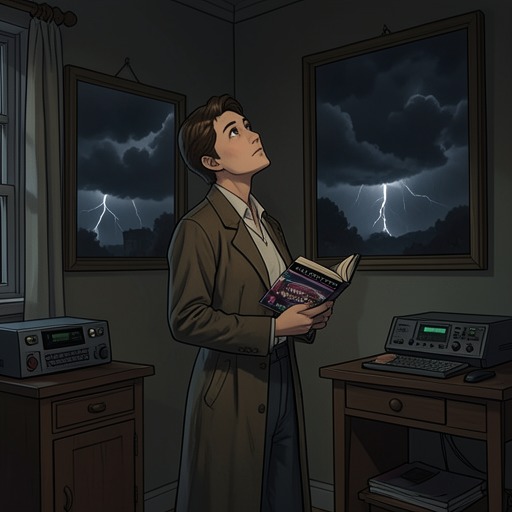
The contrast is developed through John Carpenter’s film They Live. In the film’s premise, a hidden elite uses subliminal signals in mass media to conceal its alien appearance, manipulate consumption and reproduction, and make workers accept the status quo. An underground Resistance seeks to hack the signal; when the broadcaster is destroyed, people everywhere see the aliens and the film ends abruptly. The book reads this mechanism as an image of false consciousness: an external signal creates a social reality that prevents people from recognizing their rulers.
Yet the book insists that the film’s political target is not the identity groups named by right-wing conspiracy theorists. It presents Carpenter’s aliens as an allegory for affluent followers of Ronald Reagan and therefore as a denunciation of right-wing plutocratic power. The comparison exposes a structural contradiction in the book’s own argument: it condemns fantastical theories for locating domination in secret racial or extraterrestrial agents, while retaining a sweeping account of media, capitalism, and elite control. False consciousness is consequently both a subject of criticism and a rhetorical battlefield in which rival claims to “waking up” compete.
Dehumanization and the Demand for Awakening
At its most existential level, false consciousness means estrangement from one’s own humanity. The book argues that predatory capitalism forces people to deny who they are, forget themselves, and lose unity with their own being. The worker is turned into a commodity, assigned a price, and exposed to a market in which human worth is reduced to exchange value. Consumption replaces personhood as the system’s only required purpose: the individual exists to make the rich richer.
The book’s repeated language of awakening gives false consciousness a temporal and psychological form. A false awakening is a convincing dream in which the dreamer believes sleep has ended while remaining asleep. Political support for Donald Trump becomes the book’s “classic” example: the voter experiences a sense of revolt, but the result is said to strengthen the elite. The possibility of a double false awakening makes certainty about enlightenment itself unstable, since a person who believes that the first illusion has been escaped may merely have entered another.
The prescribed answer is collective and political rather than merely private. The book argues that capitalism’s manufacture of false consciousness must be broken by recovering the power of the people from the 1%. Its final contrast is absolute: one either supports the people or supports the billionaires who prey upon them. In that sense, false consciousness is not only a condition of mistaken belief; it is the central obstacle to the book’s imagined transition from elite power to popular power.